
Your First Line of Defense Against Vision Loss
Catch Problems Before They Affect Your Vision
Your vision can change gradually, and many eye conditions develop without noticeable symptoms. Our annual eye exam in Austin evaluates your prescription, eye health, and visual function while helping detect concerns before they affect your sight. Comprehensive eye exams near North Shoal Creek include vision testing in Austin and a full refraction eye exam to ensure your prescription is current.
An Eye Exam Does More Than Update Your Prescription
Most people associate eye exams with glasses or contact lenses. While updating your prescription is important, a comprehensive eye exam also allows your optometrist to evaluate the health of your retina, optic nerve, cornea, and surrounding eye structures.
Routine eye exams help establish a baseline for your eye health and allow us to monitor changes over time.
Regular exams help track changes in the retina, optic nerve, and other structures before symptoms appear.
Routine evaluations support early detection of glaucoma, diabetic eye disease, macular degeneration, and other eye conditions.
We provide comprehensive eye exams for children, adults, and seniors.
What Happens During a Comprehensive Eye Exam?
Every exam is customized to your age, health history, lifestyle, and visual needs.
Vision Testing
We evaluate visual acuity and determine how well you see at distance and near.
Prescription Assessment
Your prescription is measured and updated when necessary to ensure your glasses or contact lenses continue meeting your vision needs.
Eye Health Evaluation
We examine the retina, optic nerve, cornea, and surrounding structures to identify signs of disease or abnormalities.
Retinal Imaging
Advanced imaging allows us to capture detailed views of the retina and monitor changes over time.
Glaucoma Screening
Your eye pressure and optic nerve health are evaluated to identify risk factors associated with glaucoma.
Our Technology Helps Protect Your Vision
We use advanced diagnostic tools to get a fuller picture of your eye health than a standard vision screening can provide. Here's what that means for you:
- OCT Imaging (Optical Coherence Tomography): Creates detailed cross-sectional images of your retina and optic nerve. This lets us catch early signs of glaucoma, macular degeneration, and diabetic eye changes before you'd ever notice a symptom.
- Optomap Retinal Imaging: Captures a wide-field photograph of your retina in seconds. You get a permanent record of your retinal health we can compare visit-to-visit, so any changes over time are clearly visible.
- Visual Field Testing: Maps your peripheral vision to detect subtle blind spots that may indicate glaucoma or neurological conditions, often long before central vision is affected.
- Auto-Refractor & Digital Refraction: Delivers a precise, repeatable starting point for your prescription measurement and uses digital technology to fine-tune your prescription more accurately than manual methods alone.
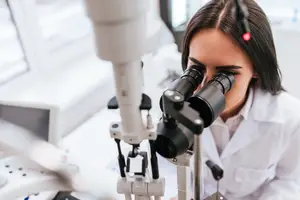
- Slit Lamp Examination: A magnified view of the front and back of your eye, revealing early cataracts, corneal issues, and retinal changes that are invisible without it.
What Can a Comprehensive Eye Exam Detect?
Many eye diseases develop gradually and may not cause symptoms in their earliest stages. Comprehensive eye exams help monitor for conditions that can affect both vision and overall eye health.
Glaucoma can damage the optic nerve without noticeable symptoms. Early detection and monitoring are critical to protecting vision.
Changes associated with diabetes may develop before noticeable vision changes occur. Regular monitoring helps protect retinal health.
Exams allow us to evaluate the ocular surface, tear quality, and factors contributing to chronic dryness and irritation.
Comprehensive eye exams help identify changes affecting central vision and support early intervention when necessary.
Nearsightedness, farsightedness, astigmatism, and presbyopia can all be identified and corrected through comprehensive testing.
Retinal abnormalities can often be detected before they begin affecting vision.
Who Should Schedule an Eye Exam and How Often?
Most adults benefit from an annual eye exam to keep their prescription current and monitor eye health. Patients over 60 face increased risk of glaucoma, cataracts, and macular degeneration—conditions where early detection through regular exams can make a significant difference in preserving vision. Seniors especially benefit from exams that go beyond a simple refraction to check overall retinal and optic nerve health.
Children and teens should be examined yearly throughout their school years. If you've ever wondered what a refraction eye exam is: it's the part of your visit where we measure how light bends through your eye to determine the most accurate prescription for you.
Children & Teens
Children should have regular eye exams throughout their school years, especially if they're struggling in the classroom, squinting, sitting close to screens, or experiencing frequent headaches.
Adults
Adults should schedule annual eye exams to monitor prescription changes, screen for eye disease, and address new symptoms such as blurred vision, headaches, floaters, or eye discomfort.
Adults Over 60
As we age, the risk of conditions such as glaucoma, cataracts, and macular degeneration increases. Annual eye exams help monitor changes and support long-term eye health.
Patients with Diabetes or Other Risk Factors
Patients with diabetes, glaucoma risk factors, or a family history of eye disease may benefit from more frequent monitoring.
Protect Your Vision With Comprehensive Eye Care
Your vision affects how you work, learn, drive, and experience daily life. Comprehensive eye exams help identify concerns early, monitor changes over time, and support lifelong eye health.
Schedule your comprehensive eye exam today and take the next step toward protecting your vision.